Cosmos Hub's Bold New Chapter: Why Its Biggest Pivot is a Stroke of Genius
Generated Title: Cosmos Didn't Fail, It Finally Found Its Soul: Why the Controversial Pivot is a Stroke of Genius
When the news broke that Interchain Labs was scrapping its plans for a native smart contract platform on the Cosmos Hub, the collective groan from parts of the crypto world was almost audible. Headlines screamed of a "builder exodus." Developers who had invested months of work, like the team at Stride, were suddenly left standing at the altar. On the surface, it looked like another classic case of crypto chaos—a project losing its way, alienating its community, and admitting defeat in the brutal Layer-1 wars.
But I've been watching this space for a long time, and when I read the announcements and the candid admissions from the leadership, I didn't see failure. When I first saw the headlines, I honestly just sat back in my chair and smiled. Because what I saw was something far rarer and infinitely more valuable: an act of profound corporate and technological self-awareness.
Cosmos isn't retreating. It’s remembering who it is. And in doing so, it might just be securing its place as one of the most vital pieces of infrastructure for the next decade of digital innovation.
The Siren Song of Being "Just Another Ethereum"
Let's be brutally honest. The world doesn't necessarily need another general-purpose smart contract platform. We have a traffic jam of them. Ethereum, Solana, and a dozen other Layer-1s and Layer-2s are all locked in a furious, capital-intensive battle for the same developers, the same users, and the same pool of "mercenary" liquidity. For Cosmos to jump into that bare-knuckle brawl would have been a fool's errand. ICL co-CEO Barry Plunkett admitted as much, saying they "got a lot of confidence that we were going over a cliff."
They were right. Trying to become another EVM-compatible chain is like a world-class architect deciding to compete with IKEA. You might be able to build a functional chair, but you're abandoning your unique genius to play a game you're not designed to win. Cosmos was never meant to be a single, monolithic blockchain that hosts thousands of dApps. Its very name, its entire design philosophy, points to a grander, more elegant vision.
The project’s core technology is the Cosmos Stack—in simpler terms, it’s a toolkit that lets anyone build their own specialized, sovereign blockchain from the ground up. Its superpower is the Inter-Blockchain Communication protocol, or IBC, which allows these independent chains to talk to each other seamlessly. This is the "Internet of Blockchains" we were promised. Why would you build the universal translator for the galaxy and then decide to spend all your resources running a single planet's marketplace? It makes no sense.
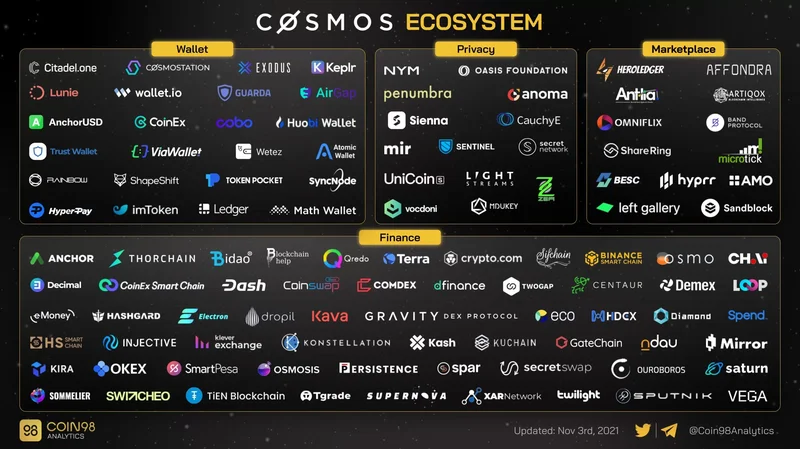
The pressure to chase the EVM narrative was immense, driven by market trends and a desire for a simple story to tell investors. But chasing that siren song was diluting the Hub's purpose and, frankly, disrespecting its own revolutionary design. What does it say about the ecosystem's confidence in its own vision if the ultimate goal is just to become a copy of someone else's?
The Genius of Choosing to Be the Rails, Not the Train
This pivot isn't an ending; it's a powerful declaration. ICL is saying, "We're not trying to be someone else. We’re going to be Cosmos—except we’re going to do it on overdrive." This is the kind of breakthrough that reminds me why I got into this field in the first place. This is a return to first principles, a doubling-down on what makes Cosmos a potential paradigm shift in how we think about digital sovereignty and connection.
Imagine the early days of the internet. Before the World Wide Web gave us a simple, graphical way to interact, there was ARPANET—the foundational infrastructure, the protocols that allowed different networks to connect. ARPANET wasn't trying to be AOL or GeoCities; it was the fundamental layer that made them all possible. That is the true role of the Cosmos Hub. It’s not meant to be the destination; it’s meant to be the interstellar highway system that connects all the destinations.
And we're already seeing the green shoots of this focused vision. While some builders are understandably frustrated, others are seeing the bigger picture. Interchain Foundation backs Stride to build IBC-native DEX on Cosmos Hub. This isn't abandonment; it's realignment. It's about building the right things in the right places.
Even more telling is the quiet institutional adoption that's happening without any hype cycles. A conglomerate of Japanese banks is already using Cosmos and IBC to transfer assets, even collaborating with SWIFT. Think about that. The old guard of global finance is plugging into this ecosystem not because it has a cool new DeFi app, but because it provides robust, secure, and sovereign infrastructure. This is the real, sustainable path to value—not chasing short-term developer incentives, but becoming indispensable. This is the moment where Cosmos stops trying to build a popular app and instead focuses on becoming a global utility, the kind of deep infrastructure that powers economies and empowers builders to create entire worlds we haven't even conceived of yet.
Of course, this path requires a new kind of social contract. The ICL team has a deep responsibility to the ATOM holders and the builders who have placed their faith in this ecosystem. The question of how ATOM accrues value in a world where the Hub is a service marketplace rather than an application platform remains the central challenge. The team's talk of transaction fees, routing services, and institutional buy-and-burn mechanisms is promising, but the execution has to be flawless. They can't afford another pivot.
But for the first time in a long time, the path forward is clear. It’s not an easy path, but it’s an honest one. It’s a vision rooted in the project's unique strengths, not in chasing the shadows of its competitors. Will Cosmos reach the predicted $50 or more in the next decade? That depends entirely on its ability to execute this new, focused mission. But by choosing to be the master of interoperability, it has given itself a fighting chance to become something far more enduring than just another fleeting Layer-1.
The Age of Specialization Has Begun
This isn't a story of failure. It's the story of a project that had the courage to look in the mirror, ignore the deafening noise of the market, and choose its own destiny. By shedding the ambition to be everything to everyone, Cosmos has cleared the way to become the one thing the entire blockchain world desperately needs: a neutral, powerful, and universal bridge to everywhere. The future isn't a single chain to rule them all; it's a cosmos of interconnected, sovereign worlds. And Cosmos is building the star-map.

-

The Business of Plasma Donation: How the Process Works and Who the Key Players Are
Theterm"plasma"suffersfromas...
-

The Manyu Phenomenon: What Connects the Viral Crypto, the Tennis Star, and the Anime Legend
It’seasytodismisssportsasmer...
-
ASML's Future: The 2026 Vision and Why Its Next Breakthrough Changes Everything
ASMLIsn'tJustaStock,It'sthe...
-

The Nebius AI Breakthrough: Why This Changes Everything
It’snotoftenthatatypo—oratl...
-

The Great Up-Leveling: What's Happening Now and How We Step Up
Haveyoueverfeltlikeyou'redri...
- Search
- Recently Published
-
- Misleading Billions: The Truth About DeFi TVL - DeFi Reacts
- Secure Crypto: Unlock True Ownership - Reddit's HODL Guide
- Altcoin Season is "here.": What's *really* fueling the latest altcoin hype (and who benefits)?
- The Week's Pivotal Blockchain Moments: Unpacking the breakthroughs and their visionary future
- DeFi Token Performance Post-October Crash: What *actual* investors are doing and the brutal 2025 forecast
- Monad: A Deep Dive into its Potential and Price Trajectory – What Reddit is Saying
- MSTR Stock: Is This Bitcoin's Future on the Public Market?
- OpenAI News Today: Their 'Breakthroughs' vs. The Broken Reality
- Medicare 2026 Premium Surge: What We Know and Why It Matters
- Accenture: What it *really* is, its stock, and the AI game – What Reddit is Saying
- Tag list
-
- Blockchain (11)
- Decentralization (5)
- Smart Contracts (4)
- Cryptocurrency (26)
- DeFi (5)
- Bitcoin (30)
- Trump (5)
- Ethereum (8)
- Pudgy Penguins (5)
- NFT (5)
- Solana (5)
- cryptocurrency (6)
- XRP (3)
- Airdrop (3)
- MicroStrategy (3)
- Plasma (4)
- Zcash (7)
- Aster (10)
- qs stock (3)
- mstr stock (3)
- asts stock (3)
- investment advisor (4)
- morgan stanley (3)
- ChainOpera AI (4)
- federal reserve news today (4)