An Extraordinary Roman Discovery in Croatia: What We Know About Their Final Days and Why This Discovery Matters
The Croatian Paradox: Building a 22nd-Century Nation on 3rd-Century Bones
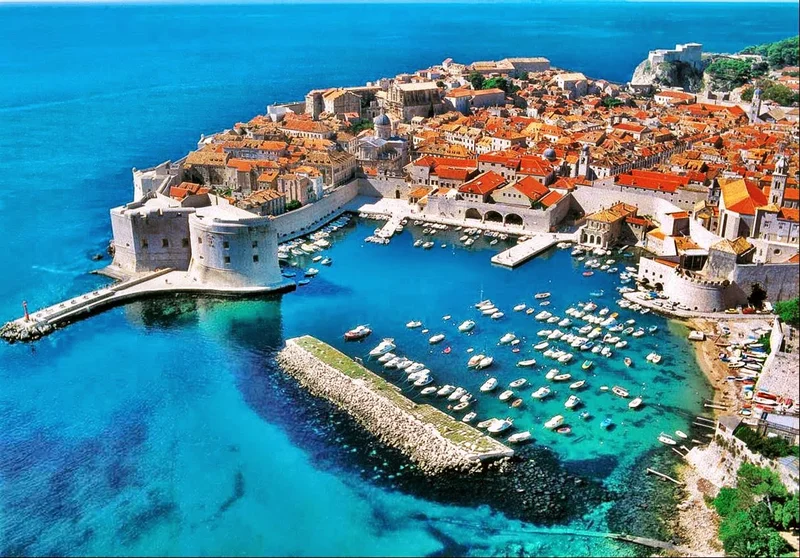
I want you to picture something. Imagine the largest, most technologically advanced warship ever built by humankind—the USS Gerald R. Ford, a $13 billion behemoth of steel and nuclear power, bristling with 75 of the deadliest aircraft on Earth—slicing through the impossibly blue waters of the Adriatic. It sails past islands that have been inhabited for millennia, toward the ancient port city of Split, a city literally built within the walls of a retired Roman emperor’s palace.
This isn’t a scene from a sci-fi novel. It’s happening right now. And for me, that single image captures one of the most fascinating and hopeful stories unfolding in the world today. It’s a story about a nation that is simultaneously reaching into its deepest past and making a radical bet on its future. While the world is distracted by endless cycles of division and decline, Croatia is quietly building a blueprint for national reinvention. And it’s a blueprint we all need to be studying.
Most people see the USS Ford’s visit as a simple geopolitical handshake, a show of NATO force. They’re not wrong, but they’re missing the bigger picture. This isn't just about military alliances. It's about a spotlight being thrown on a nation in the middle of a profound transformation. What does it mean when the pinnacle of 21st-century military tech docks in a harbor that has seen Roman galleys, Venetian traders, and now, a new generation of luxury yachts being built in its own shipyards? It means the world is starting to pay attention. But what they’re seeing is so much deeper than a port of call.
The Ghosts in the Well and the Code of the Future
Just a few hundred kilometers from where the Ford’s crew is enjoying shore leave, archaeologists recently pulled the story of another army from the Croatian soil. In a well in Osijek, they found the remains of seven Roman soldiers, a discovery that made headlines as Seven Roman Soldiers Found Packed Into A Well In Croatia. When I first read about this, I was captivated. But it wasn't the gruesome details of their deaths that struck me; it was who they were.
Isotope analysis revealed these men, who fought and died together under one Roman banner, came from all over the empire. They were a heterogeneous force, a melting pot of cultures united by a common purpose. They were proof, preserved in the earth for nearly 1,800 years, that this land has always been a crossroads. This is the kind of breakthrough that reminds me why I got into this field in the first place—it's where data and humanity collide to tell us something profound about ourselves.
Now, hold that thought—a multicultural Roman legion—and look at what the modern Croatian government is doing. They’re facing a very different kind of crisis than the Romans did: a demographic one, a "brain drain" that has seen its brightest minds leave for opportunities abroad. Their solution? It's not to build walls or close borders. It’s to launch one of the most ambitious repatriation and revitalization projects I’ve ever seen.
The government is essentially sending out a global call to its diaspora, a move captured in headlines like Croatia ready to welcome Croatians home with series of new measures. They’re offering entrepreneurs up to €150,000 to start businesses in underdeveloped areas, with the possibility of having half of that loan completely forgiven. In simpler terms, if you bet on Croatia, Croatia will bet on you, tearing up half your debt if you succeed in building your community. It’s a direct, powerful co-investment in people’s dreams. They’re not just offering tax breaks they’re fundamentally rethinking the social contract offering massive loan write-offs and doubling paternity leave and simplifying the recognition of foreign diplomas—it’s a holistic, top-to-bottom redesign of what it means to be a citizen in the 21st century.
This isn't just patching a leak. This is redesigning the ship. It’s a government acting like a venture capitalist, seeding its own future by empowering its people. They understand a profound truth: a nation is only as strong as its smallest communities. Are they consciously channeling the spirit of those diverse Roman soldiers, who built an empire by integrating talent from every corner? Or is it just a beautiful, historical echo?
An Invitation to Build Tomorrow
Of course, a plan on paper is just that. The real challenge is sending that message of change so clearly that it cuts through the skepticism of a generation that felt it had to leave to thrive. It’s one thing to write a law; it’s another thing entirely to rewrite a narrative. Can a government program truly convince someone who has built a life in Dublin, Berlin, or Toronto to pack up their family and return to a village that may have been shrinking for decades?
This is where the vision comes in. The Croatian plan isn’t just economic; it’s deeply human-centric. They've doubled paternity leave to 20 days, signaling a commitment to modern family structures. They're pouring resources into housing for young families and streamlining the bureaucracy that so often stifles progress. This is the hard, unglamorous work of nation-building. It’s about creating an ecosystem where people don’t just survive, but where they feel they can build a meaningful life and contribute to something larger than themselves.
This feels like the printing press moment for national policy. For centuries, the model has been centralization—funneling talent and resources into a few major cities. Croatia is trying to reverse that flow. They’re betting on a decentralized future, where a strong nation is a network of thriving, interconnected small towns and communities.
The responsibility, however, is immense. This experiment must succeed not just for Croatia, but as a model for so many other countries facing the same hollowing-out of their rural heartlands. What happens if the funds are mismanaged? What if the bureaucratic hurdles remain despite the best intentions? The risk is real, but the cost of doing nothing is so much higher.
So as the F-35s rest on the deck of the USS Ford in Split’s harbor, they sit as silent witnesses to this quiet revolution. One is a symbol of centralized power, a projection of strength across the globe. The other, the Croatian experiment, is a symbol of distributed power, a project to pull strength back home. It's a beautiful paradox: a nation drawing on the lessons of its ancient, imperial past to build a future that is decentralized, human-scale, and profoundly hopeful.
A Nation Rewriting Its Own Code
Forget what you think you know about national decline or the inevitability of brain drain. What's happening in Croatia isn't just a set of policies; it's a fundamental shift in mindset. It's a nation looking at the modern world's challenges and refusing to accept the foregone conclusions. They are actively, deliberately, and courageously designing their own future, betting everything on the simple, powerful idea that the most valuable resource a country has is its own people—and that home is something worth building together. We should all be watching, and taking notes.

-

The Business of Plasma Donation: How the Process Works and Who the Key Players Are
Theterm"plasma"suffersfromas...
-
ASML's Future: The 2026 Vision and Why Its Next Breakthrough Changes Everything
ASMLIsn'tJustaStock,It'sthe...
-
The Manyu Phenomenon: What Connects the Viral Crypto, the Tennis Star, and the Anime Legend
It’seasytodismisssportsasmer...
-

The Nebius AI Breakthrough: Why This Changes Everything
It’snotoftenthatatypo—oratl...
-
Secure Crypto: Unlock True Ownership - Reddit's HODL Guide
Alright,folks,let'stalkcrypto....
- Search
- Recently Published
-
- Misleading Billions: The Truth About DeFi TVL - DeFi Reacts
- Secure Crypto: Unlock True Ownership - Reddit's HODL Guide
- Altcoin Season is "here.": What's *really* fueling the latest altcoin hype (and who benefits)?
- The Week's Pivotal Blockchain Moments: Unpacking the breakthroughs and their visionary future
- DeFi Token Performance Post-October Crash: What *actual* investors are doing and the brutal 2025 forecast
- Monad: A Deep Dive into its Potential and Price Trajectory – What Reddit is Saying
- MSTR Stock: Is This Bitcoin's Future on the Public Market?
- OpenAI News Today: Their 'Breakthroughs' vs. The Broken Reality
- Medicare 2026 Premium Surge: What We Know and Why It Matters
- Accenture: What it *really* is, its stock, and the AI game – What Reddit is Saying
- Tag list
-
- Blockchain (11)
- Decentralization (5)
- Smart Contracts (4)
- Cryptocurrency (26)
- DeFi (5)
- Bitcoin (30)
- Trump (5)
- Ethereum (8)
- Pudgy Penguins (5)
- NFT (5)
- Solana (5)
- cryptocurrency (6)
- XRP (3)
- Airdrop (3)
- MicroStrategy (3)
- Plasma (4)
- Zcash (7)
- Aster (10)
- qs stock (3)
- mstr stock (3)
- asts stock (3)
- investment advisor (4)
- morgan stanley (3)
- ChainOpera AI (4)
- federal reserve news today (4)