XRP Price Today: What the Price Action and Latest News Signal
Beyond the Panic: Deconstructing XRP's $19 Billion Liquidation Cascade
Friday’s session was a bloodbath. There's no clinical way to describe it. Across the digital asset space, screens bled red as a wave of liquidations—some $19.38 billion across all digital assets—tore through order books. For XRP, the event was particularly brutal. The token plunged as much as 42% in a single day, collapsing from a high of $2.83 to a gut-wrenching low of $1.77 before finding any semblance of a floor.
On the surface, this looks like classic capitulation. A widespread loss of faith sending investors rushing for the exits. The usual chorus of social media panic, technical analysts pointing to broken support levels, and validators like "Vet" tweeting reassurances ('XRP Going Nowhere': XRP Ledger Validator Reacts as Crazy Volatility Hits Market) all played their parts in the familiar drama.
But when you peel back the first layer of price action and look at the underlying mechanics, the narrative of a simple investor exodus falls apart. The data suggests this wasn't a referendum on XRP's fundamental value. It was something else entirely: a violent, derivatives-driven purge that punished leveraged speculators while providing a massive accumulation opportunity for the market's largest players. The real story isn't about who sold, but about who was forced to sell—and more importantly, who was waiting to buy.
The Anatomy of a Leverage Flush
To understand what happened, one must first distinguish between a spot-driven sell-off and a derivatives-led cascade. A spot-driven crash is straightforward: holders lose conviction, send their tokens to exchanges, and sell them on the open market. This is a genuine signal of changing sentiment. We would see a massive spike in the supply of XRP on exchanges.
That is not what the on-chain data shows.
According to analytics from Santiment, the supply of XRP held on exchange wallets barely budged during this entire violent episode. There was no mass migration of tokens from private wallets to trading venues. This is a critical discrepancy. It tells us the selling pressure wasn't coming from long-term holders or even recent spot buyers. It originated in the futures market.
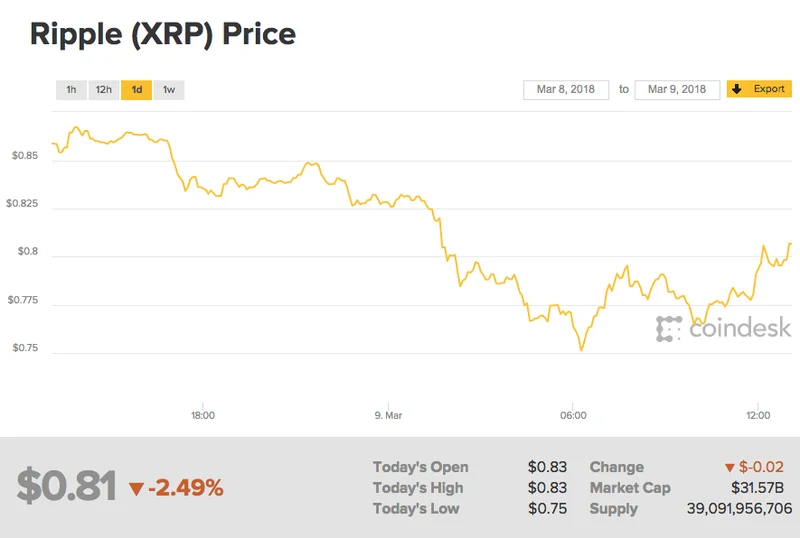
This was a classic leverage flush. Over-leveraged long positions, likely placed by traders betting on a continued rise, were liquidated as the `price of xrp` broke through key technical levels. When these positions are force-closed by exchanges, it triggers a domino effect of automated selling that cascades through the order book, driving the `xrp price usd` down further and liquidating the next tier of leveraged traders. It’s a self-perpetuating cycle that has little to do with the underlying asset’s utility and everything to do with market structure.
I've looked at hundreds of these liquidation events across different assets, and a divergence this stark between futures-led panic and spot-holder apathy is telling. The Wyckoff Volume Spread Analysis confirms this picture, showing a massive red bar of peak selling pressure followed by yellow bars indicating the forced liquidations were tapering off. This wasn't a slow bleed of conviction; it was a fast, brutal, and technically-driven washout. But if the small fish were getting fried, where were the sharks?
The Whale's Gambit
While the market was consumed by panic, a very different activity was taking place in the quiet depths of the ledger. On-chain data reveals that the largest XRP wallets—those holding more than 1 billion tokens—were not only holding steady, they were actively buying the dip.
As leveraged positions were being wiped out, these whale-tier addresses increased their collective holdings from 23.98 billion to 25.02 billion XRP. That’s an accumulation of over a billion XRP—to be more exact, 1.04 billion XRP, valued at roughly $2.54 billion at the time.
This is the central, unavoidable fact of the entire event. While one group was being forcibly deleveraged, the most capitalized group was systematically absorbing their positions at a discount. This behavior is the polar opposite of a market-wide panic. It's a calculated, strategic accumulation. It’s like watching a forest fire rage through the underbrush. To the casual observer, it’s chaos and destruction. But for the forest's largest, most deep-rooted trees, it’s a clearing event that removes competition and enriches the soil for future growth. The whales were not just surviving the fire; they were benefiting from it.
So what does this tell us? It suggests the largest holders view this volatility not as a threat, but as an opportunity. They are either supremely confident in XRP's long-term trajectory (perhaps waiting on Ripple's Q4 updates) or they understand the market structure well enough to profit from its inherent instabilities. While technical charts paint a confusing picture—with analysts flagging both a 20% downside risk and a potential bull flag targeting $5 (XRP Price Today: XRP Faces 20% Downside Risk Before Potential $5 Reversal)—this on-chain flow of assets from weak hands to strong hands is a far more powerful signal. It begs the question: what information or conviction do these large holders possess that the rest of the market clearly lacks? And does their buying signal that the bottom is in, or are they simply setting up for the next leg of a much longer game?
A Transfer, Not a Verdict
Let's be perfectly clear. The recent XRP crash was not a vote of no-confidence. It was a wealth transfer, executed with brutal efficiency. The event had all the hallmarks of a market functioning exactly as designed in a high-leverage environment: it flushed out weak, over-extended positions and reconcentrated assets into the hands of those with the capital to withstand the volatility. The noise around the `price of xrp today`—the panicked headlines, the conflicting technical targets—obscures this simple, mechanical truth. The most important metric to watch wasn't the price, but the flow. And the flow was decisively one-sided: from the leveraged many to the patient few. This wasn't the end of a story; it was merely the violent end of a single chapter.

-

The Business of Plasma Donation: How the Process Works and Who the Key Players Are
Theterm"plasma"suffersfromas...
-
ASML's Future: The 2026 Vision and Why Its Next Breakthrough Changes Everything
ASMLIsn'tJustaStock,It'sthe...
-
Morgan Stanley's Q3 Earnings Beat: What This Signals for Tech & the Future of Investing
It’seasytoglanceataheadline...
-

The Manyu Phenomenon: What Connects the Viral Crypto, the Tennis Star, and the Anime Legend
It’seasytodismisssportsasmer...
-

The Nebius AI Breakthrough: Why This Changes Everything
It’snotoftenthatatypo—oratl...
- Search
- Recently Published
-
- Bitcoin's Recovery: The Numbers Don't Add Up (- Reactions Only)
- Misleading Billions: The Truth About DeFi TVL - DeFi Reacts
- Secure Crypto: Unlock True Ownership - Reddit's HODL Guide
- Altcoin Season is "here.": What's *really* fueling the latest altcoin hype (and who benefits)?
- The Week's Pivotal Blockchain Moments: Unpacking the breakthroughs and their visionary future
- DeFi Token Performance Post-October Crash: What *actual* investors are doing and the brutal 2025 forecast
- Monad: A Deep Dive into its Potential and Price Trajectory – What Reddit is Saying
- MSTR Stock: Is This Bitcoin's Future on the Public Market?
- OpenAI News Today: Their 'Breakthroughs' vs. The Broken Reality
- Medicare 2026 Premium Surge: What We Know and Why It Matters
- Tag list
-
- Blockchain (11)
- Decentralization (5)
- Smart Contracts (4)
- Cryptocurrency (26)
- DeFi (5)
- Bitcoin (30)
- Trump (5)
- Ethereum (8)
- Pudgy Penguins (5)
- NFT (5)
- Solana (5)
- cryptocurrency (6)
- XRP (3)
- Airdrop (3)
- MicroStrategy (3)
- Plasma (4)
- Zcash (7)
- Aster (10)
- qs stock (3)
- mstr stock (3)
- asts stock (3)
- investment advisor (4)
- morgan stanley (3)
- ChainOpera AI (4)
- federal reserve news today (4)